
Generative engine optimization: how to get cited by AI answers
What GEO adds to SEO, how AI answers choose the brands they name, and how to measure it week after week.
Generative engine optimization (GEO) extends SEO to the places where a written answer replaces the list of links. The goal is no longer only to rank. It is to be named in the answer an AI writes, and to be the page it opens to write it.
GEO vs SEO: what actually changes
In SEO, a result reads as a position: your page ranks third or twelfth for a query. A generated answer has no twelfth position. ChatGPT, Gemini, Perplexity, Google AI Overviews and Google AI Mode write a paragraph, name a handful of brands and cite a handful of pages. You are in it, or you are not.
GEO builds on SEO: surfaces that read the web run their own searches and write from the pages they find. But a well-ranked page is not automatically cited, and a brand that gets named doesn't necessarily get a page cited. So two outcomes need tracking separately:
- a mention: the AI names your brand in its answer;
- a source citation: the AI opens and references a page on your site.
How AI answers pick the brands they name
With web search on, a buyer question such as “what are the best running shoes for beginners?” is broken into several searches. The AI reads the pages that come back, then summarizes. The brands it names are often the ones those pages already name: comparison sites, reviews, forums, trade media, retailer listings.
That is why much of GEO happens off your own site. In the Hypervisible Nike demo, the domains AIs cite most after nike.com are reddit.com, runrepeat.com, adidas.com, rei.com and businessinsider.com. Several are cited on questions where Nike doesn't appear at all: those are sources to win.
Surfaces also behave differently. In the same reading, Nike's weighted presence ranges from 24% in AI Overviews to 59% in Perplexity and AI Mode. GEO has to be managed surface by surface, not through one blended average.
GEO tactics that hold up
Answer the questions buyers really ask
Start from measured demand: the questions your buyers put to AIs and to Google, with their volume. One high-demand question where you are missing is worth more than ten rare ones where you are already cited.
Show up on the pages AIs open
List the domains cited on your questions and work on the ones that ignore you: comparison sites, forums, retailer listings, trade media.
Make your pages easy to cite
AIs cite pages that answer directly: a short answer at the top of each section, dated and sourced figures, headings that echo the question, and structured data that matches the visible text.
Remove ambiguity about who you are
If your name is shared with another company, a place or a common word, AIs can mix you up. Use the same full name everywhere and link your official profiles to each other.
Measuring GEO without fooling yourself
Three mistakes skew most GEO measurement:
- Mixing questions that name you with the rest. A question containing your brand almost always gets an answer that mentions it, which inflates the rate. Hypervisible tracks those separately, as reputation.
- Counting every question the same. A question asked thousands of times a month shouldn't weigh the same as one asked ten times: a weighted rate gives each one the weight of its demand.
- Reading a single number. Answers vary from hour to hour. Reliable measurement re-runs the same cohort at a fixed interval and reports the change in points.
That is how Hypervisible works: every Monday, the same real-demand questions go to all five surfaces, and the change shows in points.
A worked example
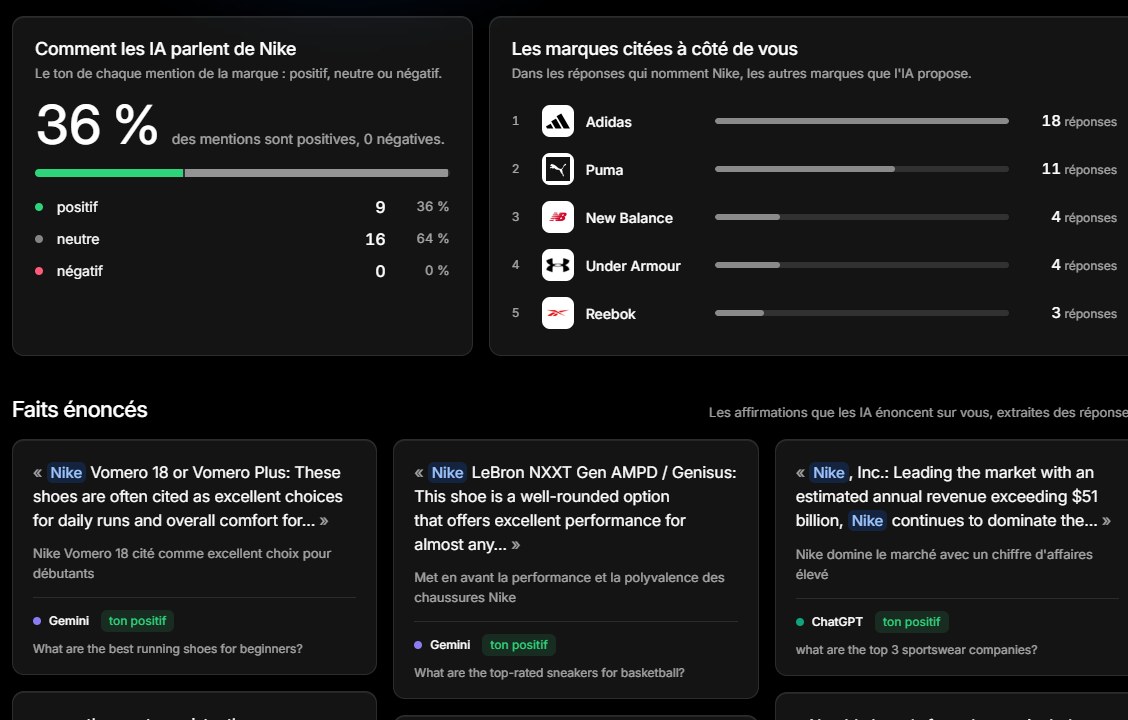
Across 30 questions on five surfaces (Nike demo, United States, September 28, 2026), Nike's weighted citation rate is 49% (32% raw), and its weighted share of voice is 33%, ahead of Adidas (27%) and Puma (17%). 36% of mentions are positive; none are negative.
| Surface | Presence |
|---|---|
| ChatGPT | 45% |
| Gemini | 58% |
| Perplexity | 59% |
| Google AI Overviews | 24% |
| Google AI Mode | 59% |
The free scan asks five buyer questions to three surfaces and shows a score out of 100 with its formula, in under two minutes. What it covers is detailed in our AI visibility checker guide.
Frequently asked questions
Is GEO replacing SEO?
No. Surfaces that read the web rely on pages that search engines find and rank. GEO adds two goals: being named in the answer, and being the page that gets cited. A site search engines struggle with is unlikely to be read by an AI; a site that ranks well is not cited for that reason alone.
What's the difference between GEO, AEO and LLMO?
Three names for closely related practices. GEO targets generated answers, AEO (answer engine optimization) targets answer engines, LLMO (large language model optimization) targets language models. The levers overlap: answer real questions, be present on the sources AIs read, and remove ambiguity about your name.
How long does GEO take to show results?
It depends on the surface. Surfaces that read the web at answer time can pick up a page as soon as it surfaces in their searches. What models know from training moves more slowly. That is why a fixed-interval reading on a constant cohort matters: it separates real movement from noise.